
From a question to a prediction.
Every forecast goes through a multi-agent prediction pipeline: question analysis, research planning, parallel investigation, critic review, evidence filtering, ensemble forecasting, and final consensus synthesis. Swarms can scale to 100 million model workers per request before the written forecast lands in your dashboard.
Six stages, one clear answer.

1. Question Intake & Routing
Evaluator models size up the question; reviewer models converge on classification, complexity, risk, and how much research the forecast needs.
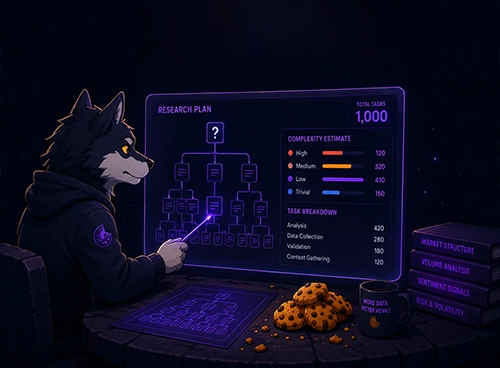
2. Research Decomposition
A planner breaks the main question into parallel research tasks — a few for simple prompts, many more for complex ones.
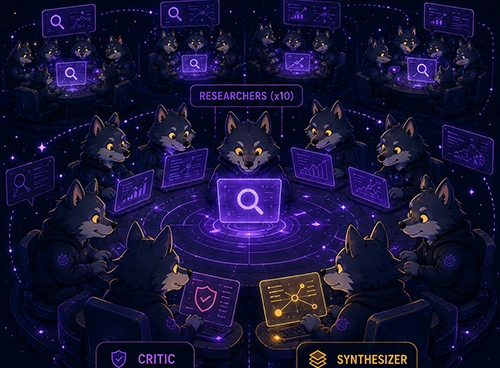
3. Parallel Research Swarm
Researchers investigate each task; critic and synthesizer roles bundle findings into structured research packets, not raw chat.
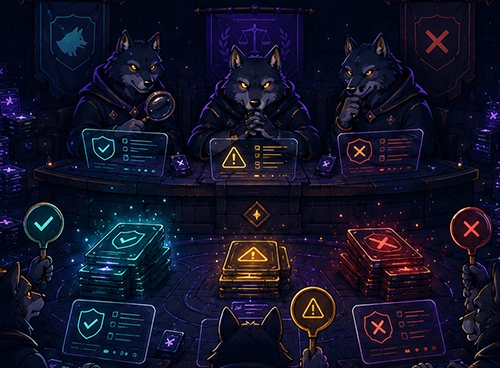
4. Research Packet Tribunal
Critic models accept, revise, discard, or downgrade evidence — only strong packets move on to forecasting.
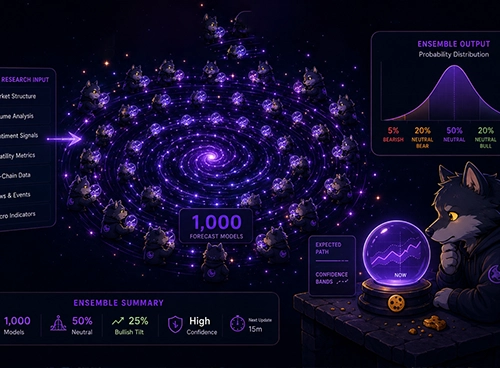
5. Forecast Ensemble
A large jury of independent forecasters each produces a forecast, building a distribution of outcomes instead of one hasty answer.
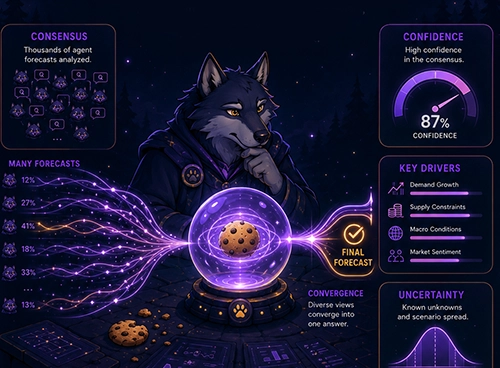
6. Final Consensus Synthesis
A synthesizer reconciles majority and minority views, probability, confidence, and uncertainty into one clear, user-facing forecast.
The full prediction pipeline.
Every step is intentional. Here is what happens between the moment you press Generate Prediction and the moment your forecast is ready.
-
01
Ask a specific question
Start with a future-facing question — weather, sports, politics, tech, markets, entertainment, culture, business, personal planning, anything. The clearer the prompt, the better the swarm can aim decomposition and research.
Good prompts include location, dates, names, constraints, context, and the outcome you want forecasted.
-
02
Question intake and routing
Evaluator models independently score complexity, category, time horizon, risk, and likely research needs. Reviewer models then converge on a consensus routing packet — how deep the research should go and which paths matter.
This intake layer is forecast routing: it decides how much of the pipeline wakes up for your question.
-
03
Research decomposition
A planner model receives the consensus intake packet and breaks the main question into parallel research tasks — from a handful for narrow prompts to large bundles for multi-factor forecasts.
Simple questions stay lightweight; complex questions spin up many investigative threads without you micromanaging each step.
-
04
Parallel research swarm
Each task gets researchers suited to its difficulty. Alongside them, critic roles inspect research quality and synthesizer roles merge findings into structured research packets — evidence bundles, not loose model chatter.
The swarm can scale to 100 million model workers across these roles when the forecast demands it.
-
05
Research packet tribunal
When packets return, critic models run adversarial review — marking evidence as accepted, revised, discarded, outdated, contradictory, or downgraded in confidence.
Only packets that survive this tribunal advance. Weak signals are filtered before they can skew the forecast jury.
-
06
Forecast ensemble
Approved research feeds a large ensemble of independent forecasters. Each produces its own prediction, forming a distribution of outcomes rather than a single model guess.
This forecast jury stage is where disagreement and uncertainty stay visible before synthesis.
-
07
Final consensus synthesis and delivery
A synthesizer ingests the ensemble: majority and minority views, probability consensus, confidence, strongest evidence, open uncertainty, and model disagreement. It writes the final readable forecast.
The result lands on your dashboard; opt into email when it completes. Pending jobs stay visible while processing continues.
-
08
Community, privacy, and learning
Share forecasts publicly so others can browse and react, or keep sensitive prompts private with one toggle. Agree/disagree votes become popularity and quality signals over time.
Every public prediction also feeds aggregate learning — routing, depth, critique behavior, and summaries should improve as usage grows, compounding forecast quality for the community.
Six roles. One forecast.
The model swarm doesn't run as a single chatbot — evaluators, planners, researchers, critics, synthesizers, and forecasters hand off across intake, research, tribunal, ensemble, and final synthesis.
- Evaluators classify questions and converge on routing signals.
- Planner decomposes the forecast into parallel research tasks.
- Researchers investigate tasks and gather competing scenarios.
- Critics challenge weak evidence in parallel research and in the packet tribunal.
- Synthesizers bundle validated packets and reconcile ensemble outputs into the final forecast.
- Forecasters form the independent forecast jury before consensus synthesis.
Tips for sharper questions.
Be specific
Name the event, place, people, and timeframe. "Will it rain in Fate, TX on June 4, 2026?" beats "Will it rain soon?"
Anchor a timeframe
Forecasts get stronger when the window is clear. Pin a date, a season, or a specific event horizon.
State the outcome you want
Tell the system what "yes/no", value, ranking, or scenario you want it to forecast.
Add useful context
Constraints, recent news, or background details help research workers focus on the right signals.
Credits per prediction
Public predictions cost 10 credits. They may appear in the public archive and feed signals that improve routing, evaluation, and quality over time.
Private predictions cost 20 credits. They stay off the public feed and do not contribute community learning in the same way, while still using the full AI pipeline.
New users get a starting balance to try the platform. Credits help manage compute-heavy workflows fairly as we grow.
Invite-only access
HowlingCookie is currently invite-only. New accounts need a valid invitation code from an existing member. Once you're in, you can invite others as your invite balance allows.
For education and entertainment only
HowlingCookie predictions are for educational and entertainment purposes only. They are not financial, medical, legal, or lifestyle advice and should not be treated as guarantees. Always consult qualified professionals before acting on any information.
Ready to put the swarm to work?
Ask a sharp question. Let the swarm route, decompose, research, challenge evidence, ensemble forecasts, and synthesize the answer.